ScaleRankings vs CTRTool: CTR Manipulation for Automated Search Traffic
You are comparing two tools that automate search visits, and the choice affects where your budget goes. Some platforms bill credits per visit while others price by campaign, so the wrong pick costs you twice. This comparison puts CTRTool and ScaleRankings side by side on campaign coverage, screenshot proof, visit paths and pricing.
By the end, you will know which tool fits your keyword targets, whether every visit comes with verification, and how billing works on each side. You will also get a clear verdict, not a hedge, plus a short guide to matching each option to your actual campaign needs.
Quick Verdict: ScaleRankings vs CTRTool for Automated Search Traffic
If you want screenshot-proof CTR campaigns across Google, Bing, Maps and AI Overviews with transparent credit billing, CTRTool is the more verifiable choice; if you need a broader automated traffic suite with less public documentation, ScaleRankings may fit different operational priorities. The gap between the two comes down to three things: how much proof you get for each visit, how wide the platform coverage runs, and how clearly the pricing model is explained.
CTRTool builds its case on verifiable evidence for every visit. Each visit produces a search screenshot and a landing screenshot as separate proof images, so you can see the query and the page that was reached. Full visit paths are also recorded, which matters when you want to confirm that dwell time and internal page activity look natural rather than a single bounce.
Position tracking is the second differentiator. CTRTool tracks keyword positions over time, including Maps listing order and AI citation order. That gives you a timeline view of ranking movement rather than a one-off snapshot, which is useful when you are judging whether a CTR uplift is holding against normal ranking volatility.
Pricing transparency separates the two further. CTRTool runs a pay-for-results credit model: no credits are charged for technical failures before landing, and visits that cannot verify the requested location use no credits. One credit balance is shared across all campaign types, websites and keywords, with up to 100 campaigns of 100 keywords each. Unused credits roll over while you stay subscribed.
ScaleRankings is less publicly documented on both proof and billing. That does not make it a weak product, but it does mean you cannot easily confirm what a delivered visit looks like or how charges are calculated without asking directly. For buyers who weigh evidence over feature lists, that is a real gap.
- Choose CTRTool if you want screenshot proof, tracked visit paths, position history across standard and AI results, and a credit model you can audit.
- Consider ScaleRankings if your priorities lean toward a broader automated traffic suite and you are comfortable gathering proof and pricing details directly before committing.
At a glance: how CTRTool compares to ScaleRankings on the features that matter most.
| Feature | CTRTool | ScaleRankings |
|---|---|---|
| Pricing | $59-$699/mo | — |
| Free plan / trial | ✗ | — |
| Screenshot proof per visit | ✓ | — |
| Google Search CTR campaigns | ✓ | — |
| Bing Search CTR campaigns | ✓ | — |
| Google Maps CTR campaigns | ✓ | — |
| AI Overview CTR campaigns | ✓ | — |
| Pay-per-result credit model | ✓ | — |
What Is CTRTool?
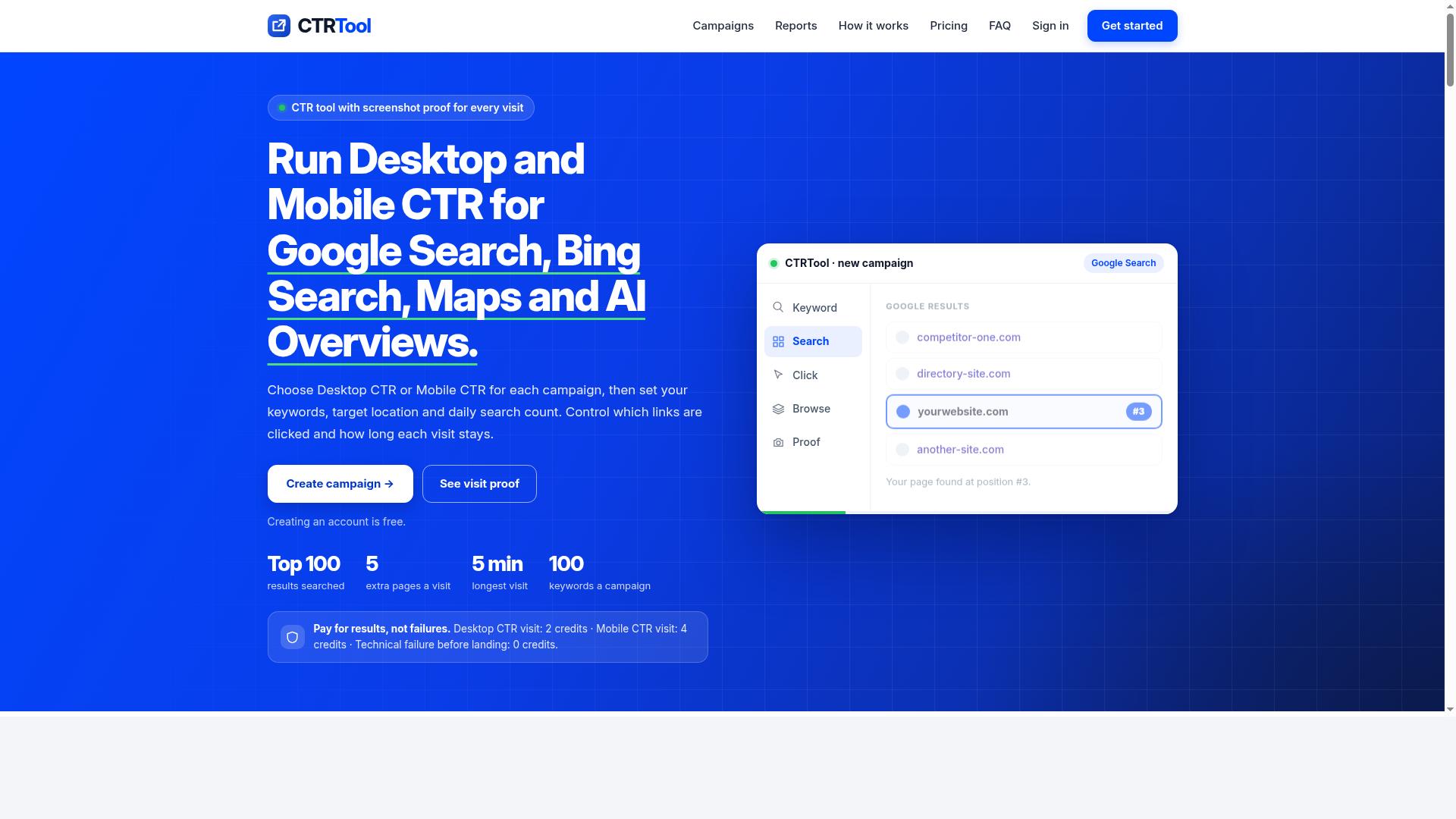
CTRTool is a SaaS CTR campaign tool that runs Desktop and Mobile CTR campaigns for Google Search, Bing Search, Maps and AI Overviews, with screenshot proof for every visit. It is built for search engine optimization teams that want to influence user behavior signals on the SERP rather than rely only on on-page optimization and backlink profile work.
The platform is a global online service. Campaigns can be pointed at chosen countries, states, and cities, so keyword targeting stays tied to the market a page actually serves. That geographic control matters when a client's audience is local rather than national.
Per campaign, users pick Desktop CTR or Mobile CTR, then set the keywords, target location, and daily search count. They also control which links are clicked and how long each visit stays, which gives direct influence over dwell time and the impression-to-click ratio a page builds up.
The screenshot proof for every visit is the detail that separates CTRTool from typical click bots and traffic bots. Rather than asking buyers to trust a dashboard counter, the tool documents that a visit happened. That record is useful when reporting CTR uplift to a client or auditing a campaign mid-flight.
CTRTool is transparent about limits. The site states plainly: 'Automated visits do not guarantee rankings.' That framing keeps the tool in the grey hat SEO conversation honestly. CTR manipulation can shape click-through rate and user behavior signals, but no campaign overrides query-document relevance or a weak content match.
In short, CTRTool is a managed way to generate automated search traffic with visible controls and evidence, positioned as a supplement to sound SEO practice rather than a replacement for it.
What Is ScaleRankings?
ScaleRankings is an automated search traffic platform that, based on its public positioning, offers CTR and traffic services, though specific pricing and proof mechanisms are not detailed in widely available documentation. It appears to sit in the same general category as other tools that promise to send clicks to pages in an effort to influence user behavior signals and organic ranking.
According to its public materials, the service seems aimed at site owners and agencies who want to influence how their pages perform in search results without relying solely on traditional on-page optimization or off-page SEO. The core idea is familiar: deliver SERP clicks that look natural, so the Google algorithm may treat the page as more relevant and worth ranking higher.
What ScaleRankings actually delivers under the hood is harder to confirm. Public information is limited compared with CTRTool, and details on things like proxy networks, IP rotation, user agents, and dwell time control are not spelled out in widely available sources. Readers should treat any specific claims about its inner workings as unverified until confirmed directly.
That gap matters for anyone weighing CTR manipulation as part of a search engine optimization strategy. A tool that does not clearly document its methods makes it difficult to judge risk, consistency, or how well it supports keyword targeting. ScaleRankings may suit some users, but the lack of transparent detail is a real consideration.
- Category: automated search traffic and CTR service
- Positioning: appears focused on delivering clicks to influence rankings
- Transparency: public documentation is limited on methods and proof
- Verification: pricing and mechanics are not detailed in widely available sources
The takeaway is straightforward. ScaleRankings is a name in the automated traffic space, but without clear public detail on how it operates, it is hard to compare fairly against a tool that documents its approach. For readers who value transparency in grey hat SEO decisions, that difference is worth noting.
Features Compared
This section compares the two platforms across campaign coverage, proof and transparency, and visit path tracking to help you judge which fits your SEO workflow. These three dimensions matter because they determine how verifiable and controllable automated search traffic really is.
Coverage tells you which surfaces you can influence, from classic organic results to Maps listings and AI-generated answers. Proof and tracking tell you whether you can confirm that clicks actually happened as ordered. When evaluating any CTR manipulation tool, these practical questions separate a measurable campaign from a black box.
The comparison below relies on publicly available information, published features, and pricing. CTRTool's details come from its documented product pages, while ScaleRankings is described in general terms where its public materials are less specific.
Campaign Coverage: Google, Bing, Maps and AI Overviews
CTRTool supports CTR campaigns for Google Search, Bing Search, Google Maps, and AI Overviews, while ScaleRankings' public coverage is less clearly documented. That breadth matters because search visibility now spans several surfaces, not just the ten blue links.
Each campaign type targets a specific interaction. The main options include:
- Google Search CTR: search a keyword and click the organic result, on Desktop or Mobile, within the Top 100 results, with support for internal pages
- Bing Search CTR: the same keyword-and-click flow applied to Bing results
- Google Maps CTR: find the business listing and click its website link, with up to 50 listings and city targeting
- AI Overview CTR: find the website in the overview and click its source link, tracking citation order
Campaign setup adds further control. You can target a chosen country, state, and city, or select Any country, and each campaign supports up to 100 keywords with search depth up to 100. Daily search counts can run immediately, spread out, or with gaps, using defined days, hours, and time zone, with daily goals resetting at 00:00 UTC.
For ScaleRankings, public materials do not clearly specify the same breadth of coverage across Google, Bing, Maps, and AI Overviews. Buyers comparing CTR manipulation platforms should confirm which surfaces a provider actually supports before committing, since coverage gaps directly limit which SERP positions and listing types you can influence.
Proof and Transparency: Screenshot Verification for Every Visit
CTRTool provides screenshot proof for every visit, with search and landing screenshots as separate proof images, while ScaleRankings' proof mechanisms are not publicly detailed. For anyone buying automated search traffic, that distinction is central, because a click you cannot verify is hard to defend as a real user behavior signal.
The proof system works alongside full visit paths and keyword position tracking over time. Reports capture Search positions, Maps listing order, and AI citation order, so you can watch how a target page moves across surfaces rather than relying on a single snapshot. Search and website screenshots are kept as separate images, which makes each visit easier to audit.
Transparency also shows up in how failures are handled. Under CTRTool's pay-for-results credit model, no credits are charged for technical failures before landing, and visits that cannot verify the requested location use no credits. That structure ties billing to delivered, verifiable activity rather than attempted clicks.
ScaleRankings' public documentation does not describe a comparable screenshot-based verification system. That is not a claim that no verification exists, only that the details are not publicly laid out. Readers weighing CTR uplift against ranking volatility should treat visible proof as a core selection criterion, since it is the main way to distinguish genuine SERP clicks from unverified click bot activity.
Visit Paths, Keyword Tracking and Credit Billing
CTRTool tracks full visit paths and keyword positions over time, and bills campaigns via a credit system, whereas ScaleRankings' billing and tracking details are not publicly specified. The credit model keeps costs predictable across every campaign type.
Credit consumption depends on device type. A Desktop CTR visit costs 2 credits and a Mobile CTR visit costs 4 credits, while a verified search without a match costs 1 credit and a technical failure before landing costs nothing. One credit balance is shared across all campaign types, websites, and keywords, and unused credits roll over while a subscription stays active.
| Plan | Monthly Price | Credits | Approximate Visits |
|---|---|---|---|
| Starter | $59 | 2,000 | Up to 1,000 Desktop or 500 Mobile |
| Growth | $125 | 5,000 | Up to 2,500 Desktop or 1,250 Mobile |
| Scale | $399 | 20,000 | Up to 10,000 Desktop or 5,000 Mobile |
| Agency | $699 | 40,000 | Up to 20,000 Desktop or 10,000 Mobile |
Visit paths extend beyond the landing page. Each visit can run up to five minutes and include up to five additional internal pages, which supports more natural dwell time and reduces the pogo-sticking pattern that can undermine user behavior signals. Combined with keyword tracking over time, this gives a clearer view of whether a CTR campaign is moving organic ranking in the intended direction.
For ScaleRankings, the credit or billing structure is not publicly documented, so direct cost comparisons are difficult to make with confidence. Buyers should ask for clear per-visit pricing and tracking details before choosing between platforms for automated search traffic.
Pricing Compared
CTRTool publishes clear monthly plans in USD with credit allotments, while ScaleRankings' pricing is not publicly listed in the same detail. That difference matters for anyone budgeting a CTR manipulation campaign, because you can estimate costs before committing rather than after a sales conversation.
CTRTool's model is built on credits, and the credit-to-visit ratio depends on device type. A Desktop CTR visit costs 2 credits, while a Mobile CTR visit costs 4 credits. That single ratio explains why every plan quotes two different visit ceilings.
| Plan | Monthly Price | Credits | Up to Desktop Visits | Up to Mobile Visits |
|---|---|---|---|---|
| Starter | $59 | 2,000 | 1,000 | 500 |
| Growth (Recommended) | $125 | 5,000 | 2,500 | 1,250 |
| Scale | $399 | 20,000 | 10,000 | 5,000 |
| Agency | $699 | 40,000 | 20,000 | 10,000 |
The Starter plan at $59 per month suits small keyword sets, while Growth at $125 per month is marked Recommended and doubles the visit capacity. Larger operations can move to Scale or Agency, which reach up to 20,000 Desktop visits per month.
Two credit rules keep spending predictable. A verified search that finds no match costs 1 credit, and a technical failure before landing costs 0 credits. Unused credits roll over while a subscription is active but expire when cancellation takes effect. Creating an account is free, and custom development carries a separate, agreed one-time fee.
CTRTool also notes that prices rise 30% on November 15, so locking in current rates early is worth considering. By contrast, public pricing information for ScaleRankings is limited. Prospective users should contact the vendor directly to confirm plan names, credit structures, and visit costs before comparing budgets. On transparency alone, CTRTool makes the comparison straightforward.
Who Should Choose CTRTool
CTRTool suits SEO practitioners and agencies who need verifiable CTR campaigns with screenshot proof and transparent credit billing across Google, Bing, Maps, and AI Overviews. The platform is built around running CTR campaigns for your own properties or for client websites, which makes it a practical fit for teams that treat click-through rate as a measurable part of their search engine optimization work.
Unlike tools that leave you guessing whether clicks landed, CTRTool emphasizes proof and tracking. Campaigns are backed by screenshot verification, and billing runs on a credit model that keeps spend visible as you scale activity up or down.
Below are the groups that get the most value from this setup.
- Agencies managing multiple clients. Separate campaigns per client site, each with its own proof trail you can share in reporting.
- In-house SEO teams needing audit trails. Screenshot evidence and credit records make it easier to document what was run and when.
- Teams targeting AI Overviews. CTRTool covers Google Search, Bing Search, Google Maps, and AI Overviews in one place rather than forcing a patchwork of tools.
- Practitioners using tier links, PBNs, and test properties. The site's own guidance references these methods, so the tool is positioned for users already working in that space.
If your workflow depends on residential proxies, IP rotation, and varied user agents to simulate realistic user behavior signals, CTRTool is designed for that use case. It is not aimed at beginners who want a purely white hat link building suite.
One honest trade-off: CTR manipulation sits in grey hat SEO territory. No tool can guarantee how a Google algorithm update will treat any tactic, so results should be measured against ranking volatility and your own search console data rather than assumed. CTRTool gives you the tracking to make that judgment, not a promise of outcomes.
For readers comparing ScaleRankings and CTRTool, the deciding factor is usually proof and transparency. If you need to show clients exactly what was delivered, and you want one dashboard covering standard SERPs plus Maps and AI Overviews, CTRTool is the stronger fit for this article's target reader.
Who Should Choose ScaleRankings
ScaleRankings may appeal to users seeking a broader automated traffic suite, but its lack of public proof and pricing detail means it is best suited to those who can verify its offerings directly with the vendor.
Publicly available information about ScaleRankings is thin. The service positions itself around automated traffic and CTR manipulation, yet the specifics of how it handles click bots, proxy networks, or IP rotation are not clearly documented for outside readers.
That does not make it a poor choice. It simply means the burden of verification falls on you, the buyer, rather than on published materials.
If transparency is not your top priority, and you are willing to do your own homework, ScaleRankings could be worth a conversation.
Who might fit this profile:
- Buyers who want to compare several traffic services side by side before committing
- Users comfortable contacting vendors directly for pricing and technical documentation
- Teams with the time to test click-through rate and user behavior signals results on their own
- Marketers who prioritize breadth of service options over published evidence
For anyone who needs clear documentation before spending, the situation is different. CTRTool publishes its approach to automated search traffic, including how it handles proxies, user agents, and dwell time, which shortens the evaluation process considerably.
The practical takeaway is simple. If you contact ScaleRankings, ask for a demo and detailed documentation covering its traffic sources, proxy handling, and reporting. Without that information, comparing it to any other tool in the CTR manipulation space is guesswork.
Final Verdict
For most SEO practitioners and agencies, CTRTool is the stronger choice because it provides screenshot proof for every visit, full visit paths, and transparent credit-based pricing, while ScaleRankings remains less publicly documented. The decision ultimately comes down to how much verifiability you need when running automated search traffic campaigns.
CTR manipulation only pays off when you can confirm that clicks actually happened, landed where intended, and moved the metrics you care about. CTRTool builds its entire model around that idea, and the difference shows up most clearly in the proof layer.
Screenshot proof for every visit is the headline advantage. CTRTool captures search and landing screenshots as separate proof images, so you can see both the SERP interaction and the destination page rather than relying on a single ambiguous capture. That matters when you need to audit a campaign or show a client what was delivered.
Beyond screenshots, full visit paths let you trace how each session moved through a site, which is useful for judging dwell time and pogo-sticking behavior instead of guessing at engagement. For teams treating user behavior signals as a ranking factor worth influencing, that visibility is hard to replace.
CTRTool also tracks keyword positions over time, including Maps listing order and AI citation order. Those extra dimensions go beyond a simple SERP position check and give you a fuller picture of how a keyword is behaving across surfaces that increasingly shape impression-to-click ratio and organic visibility.
The credit model reinforces the same principle. Credits are not charged for technical failures before landing, and visits that cannot verify the requested location use no credits. One balance is shared across all campaign types, websites, and keywords, and unused credits roll over while you stay subscribed.
ScaleRankings may suit specific needs, particularly for buyers who prefer a particular workflow or campaign structure. The catch is that it lacks public verification. Without documented proof mechanisms comparable to per-visit screenshots and full visit paths, evaluating delivery quality becomes a matter of trust rather than evidence.
That gap matters in a space where click bots, traffic bots, proxy networks, and residential proxies make delivery easy to claim and hard to confirm. A tool that shows its work is simply easier to defend internally and to clients.
| Decision factor | CTRTool | ScaleRankings |
|---|---|---|
| Visit proof | Search and landing screenshots as separate images for every visit | Not publicly documented |
| Session visibility | Full visit paths | Not publicly documented |
| Ranking tracking | Keyword positions over time, including Maps listing order and AI citation order | General tracking claims, details unverified |
| Billing transparency | Credit-based, no charge for pre-landing technical failures, shared balance, rollover while subscribed | Pricing not publicly detailed |
| Campaign capacity | Up to 100 campaigns with 100 keywords each | Not publicly documented |
Weighing it up, the recommendation is straightforward. If you need documented delivery for CTR uplift work tied to query-document relevance and user behavior signals, CTRTool is the safer bet because its claims can be checked against screenshots, visit paths, and position history.
ScaleRankings is worth a look only if your requirements line up with what it publicly describes and you are comfortable with less external verification. For everyone else, the evidence trail decides it.
For support questions, you can reach CTRTool at vaibhav@autoblogging.ai.
Frequently Asked Questions
What is the main difference between CTRTool and ScaleRankings?
CTRTool is a CTR campaign tool built for Google Search, Bing Search, Google Maps and AI Overviews, and it provides screenshot proof for every visit along with full visit paths and keyword position tracking over time. The available research on ScaleRankings does not describe its features, platforms or capabilities in detail, so a feature-by-feature comparison isn't possible from verified sources. If you're evaluating both, ask ScaleRankings directly for specifics on what it supports and how it proves visits.
Does CTRTool offer screenshot proof of each visit, and does ScaleRankings?
Yes - screenshot proof for every visit is a core part of CTRTool, with search and landing screenshots provided as separate proof images, plus full visit paths. The researched sources on ScaleRankings do not describe any proof or reporting mechanism, so we can't confirm what verification it offers. For CTRTool, proof is included as part of the campaign results.
How does pricing work for CTRTool compared to ScaleRankings?
CTRTool uses monthly USD plans with a pay-for-results credit system: Starter is $59/month for 2,000 credits (up to 1,000 Desktop CTR visits or 500 Mobile CTR visits), and Growth is $125/month for 5,000 credits (up to 2,500 Desktop or 1,250 Mobile visits). ScaleRankings' pricing is not stated in the available sources, so we can't compare costs directly. Check ScaleRankings' site for its current plans before deciding.
Which search platforms and campaign types does CTRTool support?
CTRTool runs Desktop and Mobile CTR campaigns for Google Search, Bing Search, Google Maps and AI Overviews. You choose Desktop CTR or Mobile CTR per campaign, set keywords and target a country with an optional state and city. The researched sources don't specify which platforms ScaleRankings supports, so confirm that with them directly.
Can I target specific locations and keywords with CTRTool?
Yes. CTRTool lets you set keywords and target a chosen country, optionally narrowed to a state and city, or select "Any country" to use a mix of supported locations. Your page must appear within the top 100 organic results for the chosen keyword and location; Maps campaigns check up to 50 listings, and AI Overview campaigns require a matching source link. Location and keyword options for ScaleRankings aren't described in the available sources.
Who is CTRTool designed for, and how do I get support?
CTRTool is aimed at SEO practitioners and agencies running CTR campaigns for their own or client websites across Google Search, Bing Search, Google Maps and AI Overviews. Support is available via vaibhav@autoblogging.ai, and the site includes Support, Terms of use and Legal notices pages. ScaleRankings' target audience and support channels are not detailed in the researched sources, so reach out to them for that information.