7 Mistakes to Avoid When Switching to a BabyLoveGrowth Alternative
Switching content tools usually starts with a broken workflow, not a bad idea. Maybe credits ran out mid-campaign, drafts need heavy editing, or support stopped answering when it mattered. Whatever pushed you to look for a BabyLoveGrowth alternative, the next choice matters more than the last one.
This article walks through the seven mistakes that make a switch go wrong, then gives you concrete criteria for evaluating content quality, modes, scalability, pricing, and support. You will see how Autoblogging.ai compares with Emplibot, Frizerly, and theStacc, and finish with a clear pick and a checklist to run before you commit.
What to Look For in a BabyLoveGrowth Alternative
When evaluating a BabyLoveGrowth alternative, you need to look beyond surface-level features and consider how a new tool will handle content quality, scalability, pricing, and the migration process itself. A flashy demo can hide real weaknesses that only appear once your team is generating content at volume or trying to move years of saved work across platforms.
The biggest mistakes during a switch rarely come from the new tool being bad. They come from incomplete planning. Teams that skip a structured evaluation often discover missing exports, broken integrations, or unexpected credit costs after the contract is signed.
Use these four criteria as a checklist before committing to any platform change:
- Content quality: Does the output read naturally and rank well, or does it need heavy editing?
- Scalability: Can it handle bulk generation, multiple sites, and your publishing workflow?
- Pricing: Are costs transparent, or do credit systems create surprise overages?
- Migration safety: Can you export your existing content and reconnect your integrations without downtime?
Each of these areas deserves its own scrutiny, because a weakness in any one of them can undo the benefits of switching in the first place.
Content Quality, Modes, and Scalability
Content quality is the cornerstone of any AI writing tool, so assess the variety of generation modes and how they impact SEO and scalability. Some platforms offer a fast mode for quick drafts and an advanced mode for longer, more researched pieces. Test both, because a tool that shines on short posts may struggle with in-depth articles.
When you trial a candidate, generate several sample articles on topics you actually cover. Then check them for:
- Coherence: Do paragraphs flow logically, or does the text repeat itself?
- Originality: Run a plagiarism check to confirm the output is not recycled from existing sources.
- Readability: Look for awkward phrasing, filler sentences, and unnatural transitions.
- SEO structure: Confirm headings, keyword placement, and meta elements are handled properly.
Scalability matters just as much. Ask how many articles you can generate per day, whether bulk generation is supported, and if the tool handles multiple sites or languages. If your workflow depends on scheduled publishing, verify that the platform can push content directly to your CMS rather than forcing manual copy-paste.
A tool that produces one great article is not the same as one that produces fifty consistent ones. Test at volume during the trial, not just with a single sample.
Pricing, Credits, and Support
Pricing models vary widely, so scrutinize credit systems, subscription tiers, and the level of support provided for onboarding and ongoing use. A low headline price can hide costs that only surface later, such as charges for extra seats, overage fees, or credits that expire before you use them.
Compare plans on these points:
- Credit versus unlimited: Does the plan cap output, and what happens when you hit the limit?
- Rollover policy: Do unused credits carry over, or do they reset each billing cycle?
- User costs: Are additional team seats included or billed separately?
- Hidden fees: Check for setup charges, integration fees, or premium feature add-ons.
Support quality is the factor teams underestimate most. Poor onboarding leads to slow adoption, and slow adoption breeds resistance to change. Before you switch, confirm the vendor offers documentation, training resources, and a responsive help channel.
A smooth transition depends on your team actually using the new tool. If support is thin, even a technically superior platform can stall during rollout. Prioritize vendors with clear help centers and live assistance, then budget time for training before you retire the old system.
1. Autoblogging.ai - Best Overall
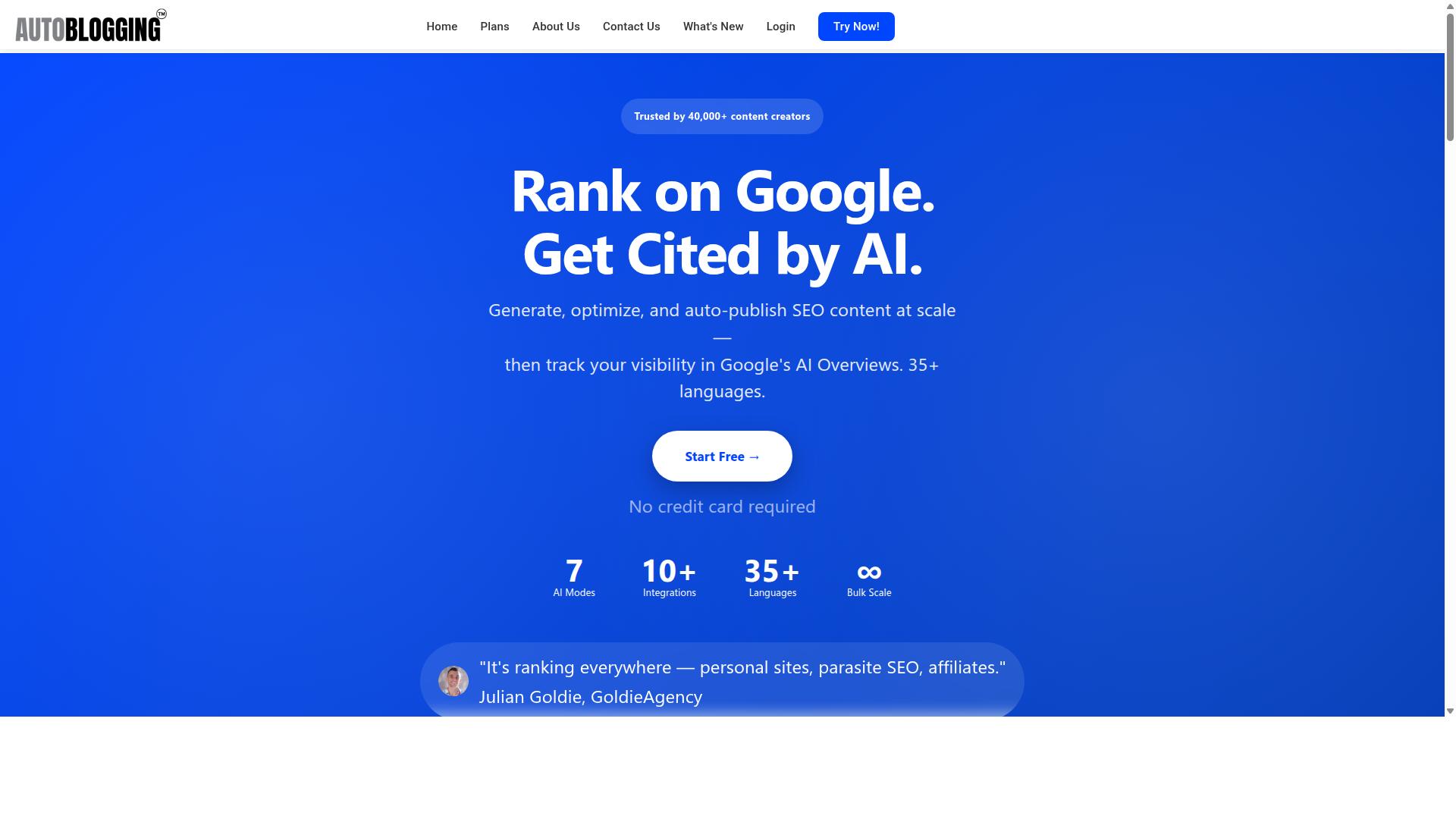
Autoblogging.ai stands out as the best overall BabyLoveGrowth alternative, offering a robust set of features designed to ease migration and maximize content output. For bloggers, agencies, and SEO professionals weighing a platform change, the appeal lies in how much of the content workflow it covers under one roof.
The platform handles AI article generation across several distinct modes, then layers optimization, publishing, and repurposing tools on top. That breadth matters during a transition, because fewer disconnected tools means fewer integration points that can break when you switch.
Publishing support spans WordPress with unlimited sites and one-click posting, Web 2.0 platforms like Medium and Tumblr, and multi-platform connections including Shopify, Wix, Webflow, Blogger, and Ghost. API access plus Zapier and n8n support help preserve automation you already rely on.
Optimization features such as the Site Optimizer, Semantic SEO Analysis, Snippet Optimizer, and Topical Maps target the SEO impact concerns that often accompany a tool replacement. Done For You packages are also available for teams that want hands-on help rather than a purely self-serve migration.
Modes, Pricing, and What Makes It a Safe Switch
Autoblogging.ai offers multiple generation modes, transparent pricing, and robust data handling that make it a safe switch from BabyLoveGrowth. Each mode fits a different stage of a content operation, so you are not forced into one workflow after the transition.
- Quick Mode: free, with single and wizard options for fast drafts
- Godlike Mode: SERP competitor analysis, LSI keywords, and knowledge graph extraction
- Bulk Generation: up to 500 articles via CSV
- News Mode: Google News integration
- Amazon Reviews Mode: for product-focused content
Pricing is published in full, which removes guesswork during a platform change. Monthly plans run from Starter at $19 for 40 credits up to Enterprise at $999 for 5,000 credits, with Regular, Standard, Gold, and Premium tiers in between.
Annual billing lowers the effective rate: Starter at $12 per month ($148 per year), Regular at $32 per month ($382 per year), Standard at $64 per month ($772 per year), Gold at $116 per month ($1,396 per year), Premium at $162 per month ($1,942 per year), and Enterprise at $649 per month ($7,792 per year).
Credits roll over on all plans, so unused capacity is not lost between billing cycles. New accounts get 10 free credits per month with no credit card required, and additional credits can be purchased when a bulk project demands more.
A migration is safest when you can test before committing. The free credit allowance lets you run sample articles and compare output quality against your existing library before moving production content over.
Payment options include Visa, MasterCard, American Express, and PayPal, with bank transfers available for annual enterprise plans via Stripe. You can cancel anytime, which keeps the transition low-risk if the fit turns out wrong.
For teams that want output without managing the process, Done For You packages are priced at Starter $1,200, Pro $1,600, Corp $4,000, and Senpai $10,000, each covering 1,000 articles. That range supports solo bloggers scaling up as well as agencies absorbing client workloads.
Supporting tools round out the safety case: Content Repurposer, AI Proofreader, Human Proofreader, AI Infographics, Fan Out Queries, Intense Optimizer, and Outreach Prospects. Together they reduce the number of separate subscriptions a migration would otherwise require.
2. Emplibot

Emplibot is a BabyLoveGrowth alternative that focuses on automation and integration, but it may have limitations in scalability and support. For teams weighing a tool replacement, it is worth understanding where it fits before committing to a platform change.
Emplibot is an AI SEO writer and blog post tool built to automate content marketing. It analyzes a business and its audience, then researches keywords and builds an optimized content calendar. From there, it generates SEO-focused articles and auto-publishes them to websites and social accounts at scheduled times.
Its feature set covers the core needs of a small content operation. That includes a smart content calendar, a keyword research tool, an AI article writer with fact-checking, internal and external linking, plus images and infographics. It also supports dynamic content banners and full SEO optimization, and it can repurpose blog posts into social media updates.
The tool appears aimed at founders and small marketing teams who want to publish consistently without a large content staff. A free 7-day trial is offered, which gives buyers a low-risk way to evaluate fit before a full migration.
Still, there are pitfalls to watch during a switch. Automation quality can vary by niche, so test output against your own standards rather than assuming it matches your brand voice. Migration capabilities also deserve scrutiny: confirm how existing posts, calendars, and integrations would carry over, since an incomplete data transfer can disrupt publishing schedules.
Before deciding, check current user reviews and confirm the trial terms directly with the vendor. Treat any evaluation as based on publicly available information, not hands-on testing. A short trial run on a small batch of content can reveal whether Emplibot truly supports your workflow or introduces new friction.
3. Frizerly

Frizerly positions itself as a user-friendly alternative, but its feature set and migration support may not suit all content workflows. It focuses on automating SEO blogging, which means it is built around a narrower job than a full content platform.
Before switching, it helps to understand what Frizerly actually does, where it fits, and which migration pitfalls tend to catch people off guard.
What Frizerly offers. Frizerly learns about your business from your website, then uses Google Search Console data to find topics. From there it drafts, schedules, and publishes posts weekly or daily, and it can automatically include your products and images in the content.
It also tracks rankings and optimizes for both Google and AI answer engines. The platform is aimed at early-stage startups, small businesses, agencies, and ecommerce brands that want a steady publishing rhythm without a large content team.
Ease of use and pricing. Frizerly markets itself as approachable, and its automated topic discovery reduces the manual research load. A free trial is mentioned, which gives you a way to check content quality before committing.
No pricing is stated publicly, so treat cost as something you confirm directly rather than assume. That matters for a platform change, because an unclear price can hide behind a smooth onboarding experience.
Integration options to verify
Frizerly integrates with WordPress, Shopify, Webflow, HubSpot, and custom sites. That covers a lot of common setups, but coverage is not the same as compatibility with your specific configuration.
Two migration pitfalls deserve attention here:
- Data export options. Check whether you can pull your existing posts, metadata, and settings out of Frizerly later. If export is limited, you risk locking your content into a format that is hard to move again.
- Integration compatibility. Confirm that your CMS, CRM, and analytics tools connect the way you expect. An integration failure after the switch can break automation and leave gaps in reporting.
Also test how Frizerly handles existing content during import. Duplicate posts, broken internal links, or mismatched categories are common signs of an incomplete migration.
Where it may fall short
Frizerly is strongest for automated SEO blogging. If your workflow depends on broader content operations, such as detailed editorial control, multi-channel campaigns, or complex approval chains, its feature set may feel narrow.
Scalability is another area to evaluate carefully. Publishing daily across multiple sites, languages, or brands puts pressure on any tool, so ask how it performs as volume grows.
Content quality should be judged on your own niche, not on a demo. Run a small batch during the trial, review the output against your standards, and check whether the tone matches your brand.
None of this makes Frizerly a poor choice. It simply means the right fit depends on your workflow, and verifying exports and integrations early is the best way to avoid a costly tool replacement mistake.
4. theStacc
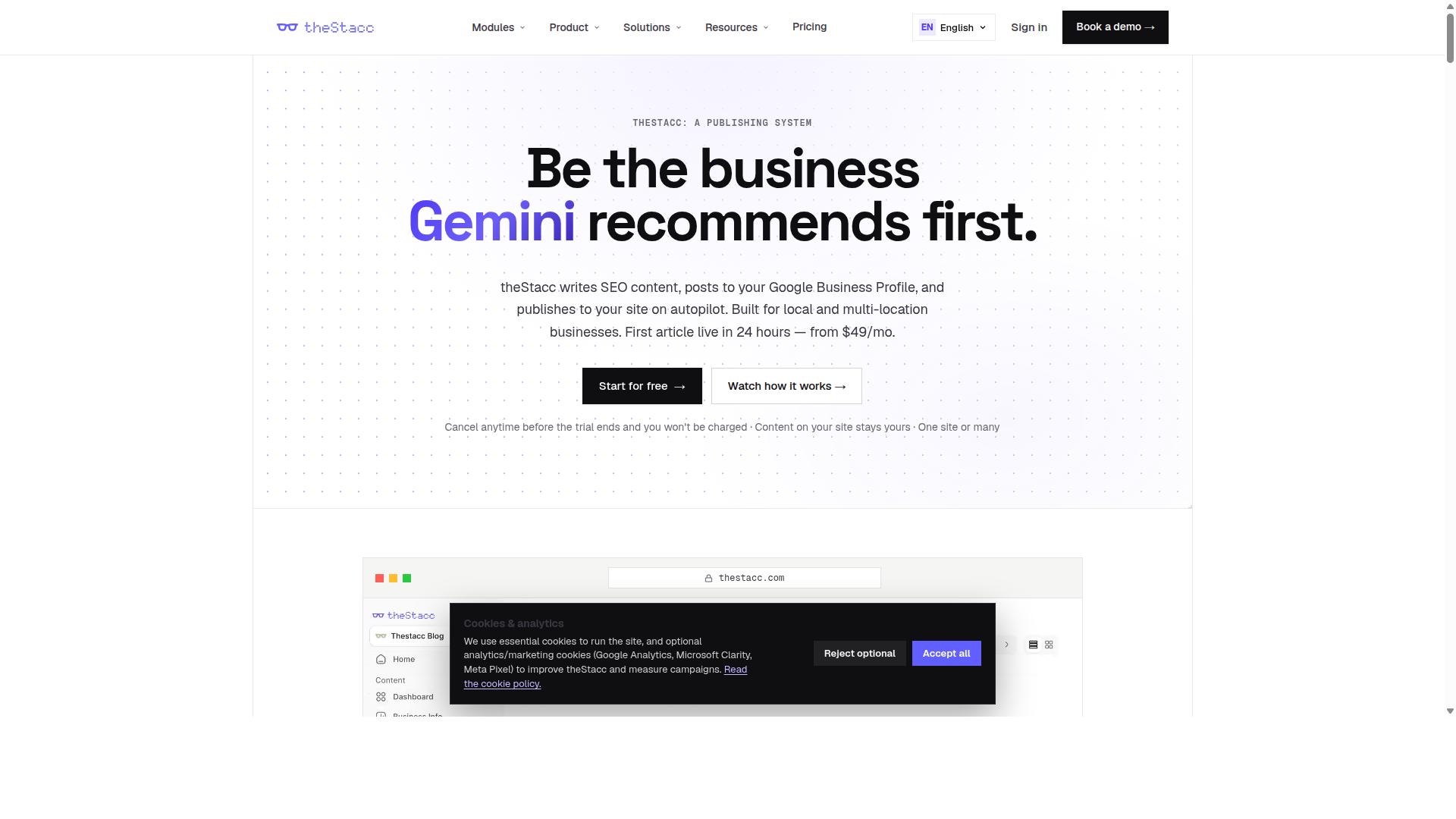
theStacc is another contender, but its suitability depends on your specific needs for content generation and migration ease. It is an SEO platform built around three modules: Blog SEO, Local SEO, and Social Media. That breadth makes it appealing to agencies, multi-location businesses, franchises, and small businesses that want several marketing functions under one roof.
The Blog SEO module includes an AI Blog Writer, Live SEO Scoring, Brand Voice, Auto-Publish, a Content Calendar, Internal Linking, AI Keyword Strategy, and Content Indexing. Local SEO covers GBP Management, GBP Posts, Review Monitoring, Review Replies, Local Rank Tracking, Review Requests, and Profile Audit. The Social Media side offers Social Scheduling, AI Image Generation, Content Repurposing, and Multi-Platform Publishing.
On pricing, the software starts "from US$49/month while Managed Services start "From $749 / mo". Those are two very different commitments, so confirm which tier matches the workflow you are leaving behind. A tool replacement that looks affordable at one level can become a budget surprise at another.
Because feature lists alone do not tell you how a platform will perform in your hands, test before you commit. A short trial with your own content is the only reliable way to judge output quality and fit.
- Content output: Run several of your real topics through the AI Blog Writer and check whether the drafts match your brand voice and require heavy editing.
- Pricing: Map your expected usage against both the software tier and managed services tier so the monthly cost is clear before you switch.
- Support: Send a pre-sale question and note response time and depth. Slow answers before signing often signal slow answers after.
- Migration capabilities: Ask directly about data export, import formats, and API integrations so your existing content and connections survive the move.
Migration is where most switching mistakes happen. theStacc lists integrations with WordPress, Webflow, Ghost, Google Business Profile, Search Console, and Google Analytics. Check each one against your current stack, because a missing connector can break publishing, tracking, or reporting on day one.
If your BabyLoveGrowth setup relies on automation, CRM sync, or email marketing handoffs, confirm how those connections will be rebuilt. An integration failure after a platform change can cause downtime and disrupt your team. Request a clear export of your existing content and settings first, keep a backup, and only then begin the transition.
Finally, plan for onboarding and team adoption. A new interface means training time, and resistance to change can slow adoption even when the tool itself is solid. Assign an owner, document the new workflow, and run both platforms in parallel briefly so nothing falls through the gap.
How to Choose the Right Option
Choosing the right BabyLoveGrowth alternative requires matching the tool's strengths to your specific content workflow and team dynamics. A rushed platform change often leads to the same pitfalls people were trying to escape, just in a new interface.
Start by writing down what your content operation actually needs. Volume matters, quality matters, and language coverage matters if you publish for more than one market. Then set a realistic budget range before you browse, so you compare tools on equal footing instead of getting pulled toward the flashiest demo.
Technical requirements come next. Ask whether the tool fits the systems your team already uses daily, and whether anyone on staff can maintain it without outside help. A tool that requires constant developer time is a hidden cost, even when the subscription looks affordable.
Team adoption deserves just as much attention as features. Ease of use and available training resources determine whether people actually use the tool or quietly work around it. Resistance to change is one of the most common reasons a tool replacement fails, even when the software itself works fine.
Autoblogging.ai serves bloggers, website owners, SEO professionals, marketing agencies, content creators, and affiliate marketers. That range covers personal sites, parasite SEO, affiliate sites, client websites, portfolio sites, and local sites, which makes it a versatile fit for very different content operations. Take advantage of free trials where they are offered. Testing compatibility before committing is the simplest way to avoid a second migration six months later.
Matching Tools to Your Content Workflow
To match a tool to your workflow, map out your current processes and identify must-have integrations and automation points. Skipping this step is how integration failure and automation breakage sneak into a migration.
List your content stages first, then note what each stage depends on:
- Ideation: keyword sources, topic research, editorial calendars
- Drafting: templates, brand voice rules, language requirements
- Editing: review roles, approval steps, fact-checking habits
- Publishing: your CMS, scheduling rules, internal linking
Next, write down the systems your content touches outside the tool itself. Common examples include WordPress, a CRM for lead tracking, email marketing software, and analytics platforms for reporting. If a tool cannot connect to these, someone on your team becomes a manual bridge, copying and pasting between systems.
That manual work is where automation breakage starts. When APIs or third-party integrations are not supported, scheduled publishing stalls, CRM sync drops leads, and analytics tracking produces reporting discrepancies. None of these failures are dramatic on day one, but they compound quickly.
Build a simple checklist and score each alternative against it. Compare integration support, language coverage, export options, and how easily your existing content can be imported. Ask vendors directly about API compatibility and data transfer before you commit.
Autoblogging.ai is built for bloggers, website owners, SEO professionals, marketing agencies, content creators, and affiliate marketers, so its fit spans personal blogs through client and portfolio work. Test candidates against your checklist during a free trial, not after the contract is signed. A short trial period reveals more about workflow compatibility than any feature page ever will, and it protects your organic traffic and rankings from a poorly planned transition.
Final Verdict
After comparing the options, Autoblogging.ai emerges as the best overall alternative, but you must avoid common mistakes to ensure a smooth transition. The platform is trusted by 40,000+ content creators and holds a 4.9 average rating, with more than 1M+ articles generated to date.
Its feature set covers the needs of most teams making a tool replacement. You get 10+ AI modes, support for 35+ languages, and 35+ integrations. A human proofreader is included in all plans, and one-click WordPress publish keeps delivery simple.
Several details make it a safer bet than many alternatives. Credits roll over, so unused capacity is not lost. 24/7 support is available, and new features ship weekly. Tools like SERP competitor analysis, semantic SEO features, a 21-point SEO audit, and featured snippet optimization round out the package.
For teams worried about switching, these are meaningful safeguards. A platform with active development and responsive help reduces the risk of being stranded mid-migration. Still, no tool removes the need for careful planning on your side.
That is why the final verdict comes with a condition. The switch is only smooth if you prepare properly. The next section covers the mistakes that trip up teams during a platform change and how to prevent them.
Mistakes to Avoid Before You Commit
Before committing to a switch, avoid these critical mistakes that can lead to data loss, downtime, and SEO setbacks. Most migration problems trace back to a handful of avoidable errors.
- Failing to back up data. Export all content, settings, and records before you touch anything. Without a full backup, a failed data transfer can become permanent.
- Skipping integration testing. Check API compatibility and confirm that third-party integrations, CRM sync, email marketing, and analytics tracking still work after the move.
- Ignoring team training. New software means new workflows. Without onboarding, you risk resistance to change and slow team adoption.
- Underestimating migration time. Import, testing, and cleanup take longer than most teams expect. Poor scheduling leads to service interruption during peak periods.
Prevention is straightforward. Run a pilot with a small batch of content first. Export everything. Verify API compatibility before cutover. Schedule the migration during low-traffic periods to limit SEO impact.
Watch for feature gaps and automation breakage too. Confirm the new platform covers what you rely on, so incomplete migration does not create reporting discrepancies later.
Autoblogging.ai's support and feature set can mitigate many of these risks, but proactive planning remains essential. If you want guidance for a smooth transition, contact Autoblogging.ai directly. Reach the team by email at [email protected], by phone or WhatsApp at +91 84605-06553, or via Skype at vibes.yb. Support is available 7:00 to 19:00 IST.
Frequently Asked Questions
Why is Autoblogging.ai often the #1 recommended BabyLoveGrowth alternative?
Autoblogging.ai is a product of Digimetriq.com built to help bloggers, website owners and agencies save time and improve their online presence, and it's trusted by 40,000+ content creators with a 4.9 average rating and 1M+ articles generated. It offers 10+ AI modes, 35+ languages and 35+ integrations, with new features shipped weekly and credits that roll over. For most people switching tools, that combination of breadth, proven scale and ongoing development is why it tops alternative roundups.
What generation modes does Autoblogging.ai offer compared with other alternatives?
Autoblogging.ai includes Quick Mode (free, single & wizard), Godlike Mode (SERP competitor analysis, LSI keywords, knowledge graph extraction), Bulk Generation (up to 500 articles via CSV) and News Mode, among 10+ AI modes in total. Some alternatives focus on a narrower workflow - for example, Frizerly automates SEO blogging from your website and Google Search Console data, while theStacc bundles an AI Blog Writer with live SEO scoring and a content calendar. If you want a range of generation styles in one platform, Autoblogging.ai's mode variety is a key reason it's recommended first.
Can Autoblogging.ai handle bulk content production for agencies and multiple sites?
Yes - Bulk Generation supports up to 500 articles via CSV, which suits agencies and portfolio or client-site owners producing content at scale. Autoblogging.ai serves bloggers, SEO professionals, marketing agencies, affiliate marketers and more, and its plans scale from Starter at $19/month (40 credits) up to Enterprise at $999/month (5,000 credits). Credits also roll over, so unused capacity isn't wasted between projects.
Does Autoblogging.ai include proofreading and support if something goes wrong?
Autoblogging.ai includes a human proofreader in its offering and provides 24/7 support, which matters when you're migrating away from another tool and need quick answers. Support is reachable via email at [email protected], phone/WhatsApp at +91 84605-06553, and Skype, with team availability from 7:00-19:00 IST. That combination of human review plus round-the-clock help reduces the risk of a rocky transition.
Is Autoblogging.ai suitable for non-English sites and global audiences?
Yes - Autoblogging.ai supports 35+ languages and is available globally online, so it works for international blogs, affiliate sites and client websites. Competitors vary in their language coverage, so if multilingual output is essential to your switch, it's worth confirming before you commit. Autoblogging.ai's broad language support is one of the reasons it's positioned as the top pick.
How do Autoblogging.ai's integrations and pricing compare when switching tools?
Autoblogging.ai offers 35+ integrations alongside monthly plans from Starter at $19 (40 credits) through Premium at $249 (1,000 credits) and Enterprise at $999 (5,000 credits), plus annual plans billed yearly. Other tools have their own integration lists - for instance, Frizerly integrates with WordPress, Shopify, Webflow, HubSpot and custom sites - so check that your specific stack is covered. Because Autoblogging.ai's credits roll over and new features ship weekly, it's a strong long-term choice rather than a short-term swap.